Americans Are Warming to China — and Cooling on Confrontation
Recent polling suggests Americans are developing more favorable views of China and are more open to a closer relationship with the country. A May 2026 YouGov survey found that the share of Americans describing China as an “enemy” had fallen 13 percentage points since July 2025, while support for closer relations had converged across Democrats, Republicans, and Independents.
The poll was released shortly after a summit between President Donald Trump and Chinese President Xi Jinping, during which the two governments agreed to a framework of “constructive strategic stability.” Trump characterized the meeting in positive terms, predicting that US-China relations would become “better than ever before.” Such elite cues can influence public opinion in the short term, especially among a president’s partisan base, and might explain why the shift was especially pronounced among Republicans.
But the summit is only part of the public opinion story. Polling from multiple organizations suggests that Americans’ views of China have been gradually becoming more positive over the past few years, and the latest surveys appear to reflect this broader trend.
Over the past two years, views of China have softened
Negative views of China have fallen substantially. Over the past two years, Pew Research Center has found a 14-point decline in the share of Americans holding a “very unfavorable” view of China, while Harvard CAPS/Harris Poll shows a similar decline from March 2024 to May 2026.
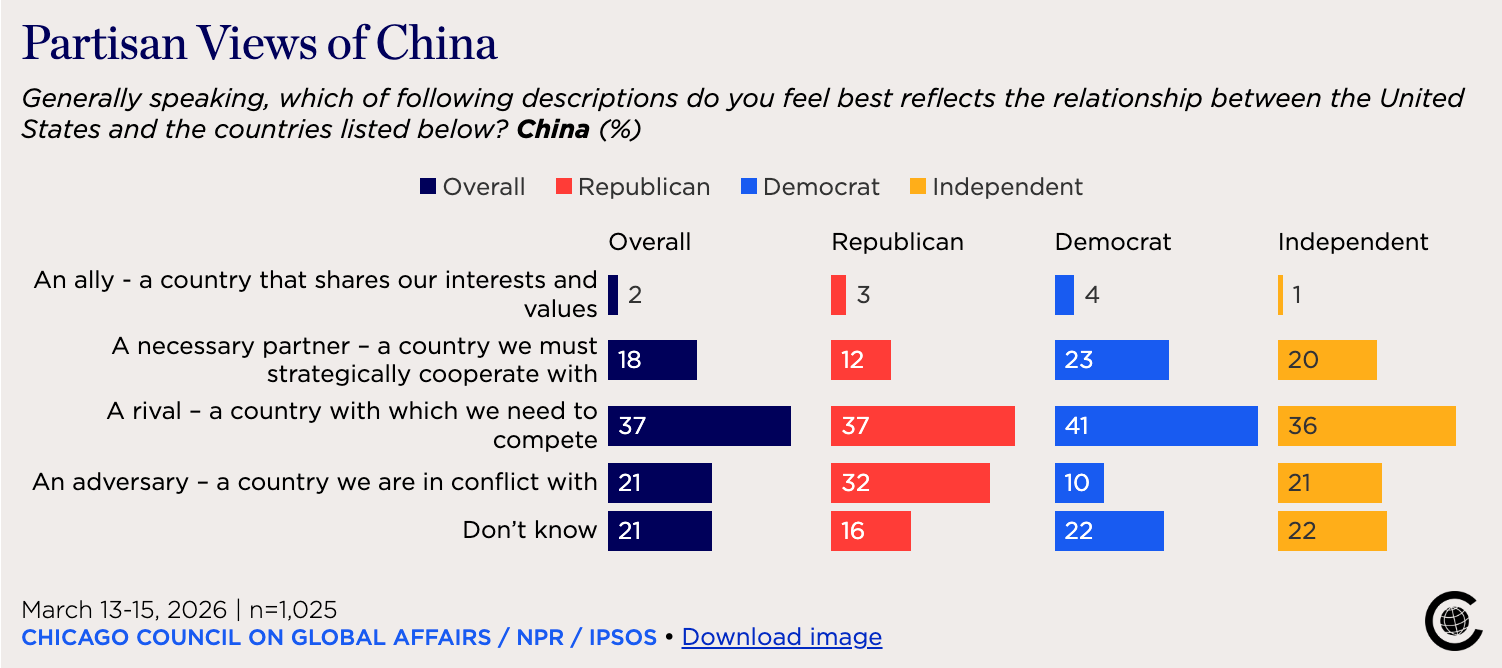
The shift becomes even clearer when Americans are asked how they characterize China. Pew’s annual surveys show that the share describing the country as an “enemy” has fallen from 42% in 2024 to only 28% in 2026, while the overwhelming majority now describe China as a “competitor.” Similarly, a 2026 NPR/Ipsos/Chicago Council survey found respondents were substantially more likely to describe China as a “rival” than an “adversary,” suggesting that Americans are moving away from framings of China rooted in outright hostility.
This does not mean that Americans no longer view China as a geopolitical challenge. The Chicago Council’s 2025 survey found that about half of Americans viewed China’s rise as a “critical threat” to national interests, and Pew’s Spring 2025 survey similarly showed that a plurality identified China as the country posing the greatest threat to the US. These concerns are consistent with broader perceptions that China is becoming an increasingly powerful global actor: a March 2026 Pew survey found that China was the only country a majority of Americans believed was growing stronger, and a 2025 Carnegie survey found that nearly three-quarters expect China to eventually surpass the United States in global power and influence.
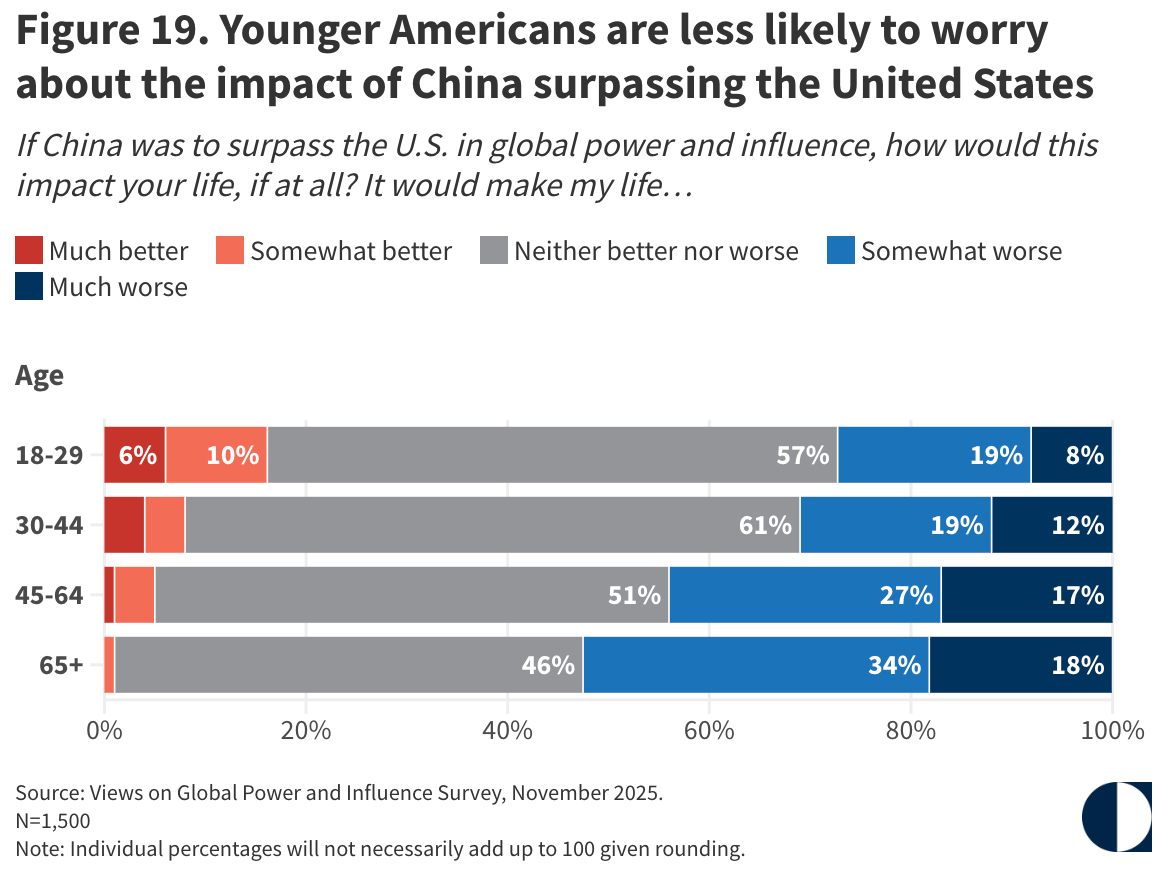
Yet Americans’ recognition of China’s growing power and challenge to national-level interests does not necessarily translate into immediate concern over impacts on their day-to-day lives. Despite widespread expectations that China will continue to gain global influence, only 3% of respondents in the 2025 Institute for Global Affairs survey ranked competition with China as a top concern. Likewise, nearly two-thirds of Carnegie respondents said their own lives would be largely unaffected — or might even improve — if China eventually surpassed the United States in global power and influence.
Several factors may be contributing to changing views on China
Recent polling points to several broader developments that may help explain why Americans are warming up to China and less likely to view its rise as a direct threat.
For many, tariff skepticism is weakening support for economic confrontation
One possible explanation is that Americans have become more skeptical of “trade war” policies that they perceive as raising costs or limiting the US economy.
A March 2026 NPR/Ipsos/Chicago Council survey found that most Americans viewed tariffs as “bad” in terms of improving their own standard of living and the US economy overall. The poll also showed that support for increasing tariffs on Chinese imports had fallen from 55% in fall of 2024 to 38% in Spring of 2026, with the greatest drops in support among Democrats and Independents.
Republicans have generally been more supportive of tariffs, but they are not unified on the issue. In February 2026 Economist/YouGov polling on tariffs more broadly, a majority of non-MAGA Republicans approved of the Supreme Court’s decision to strike down Trump’s sweeping tariffs, and a plurality favored decreasing them. MAGA Republicans, by contrast, overwhelmingly opposed the ruling and were much more likely to favor maintaining or increasing tariffs.
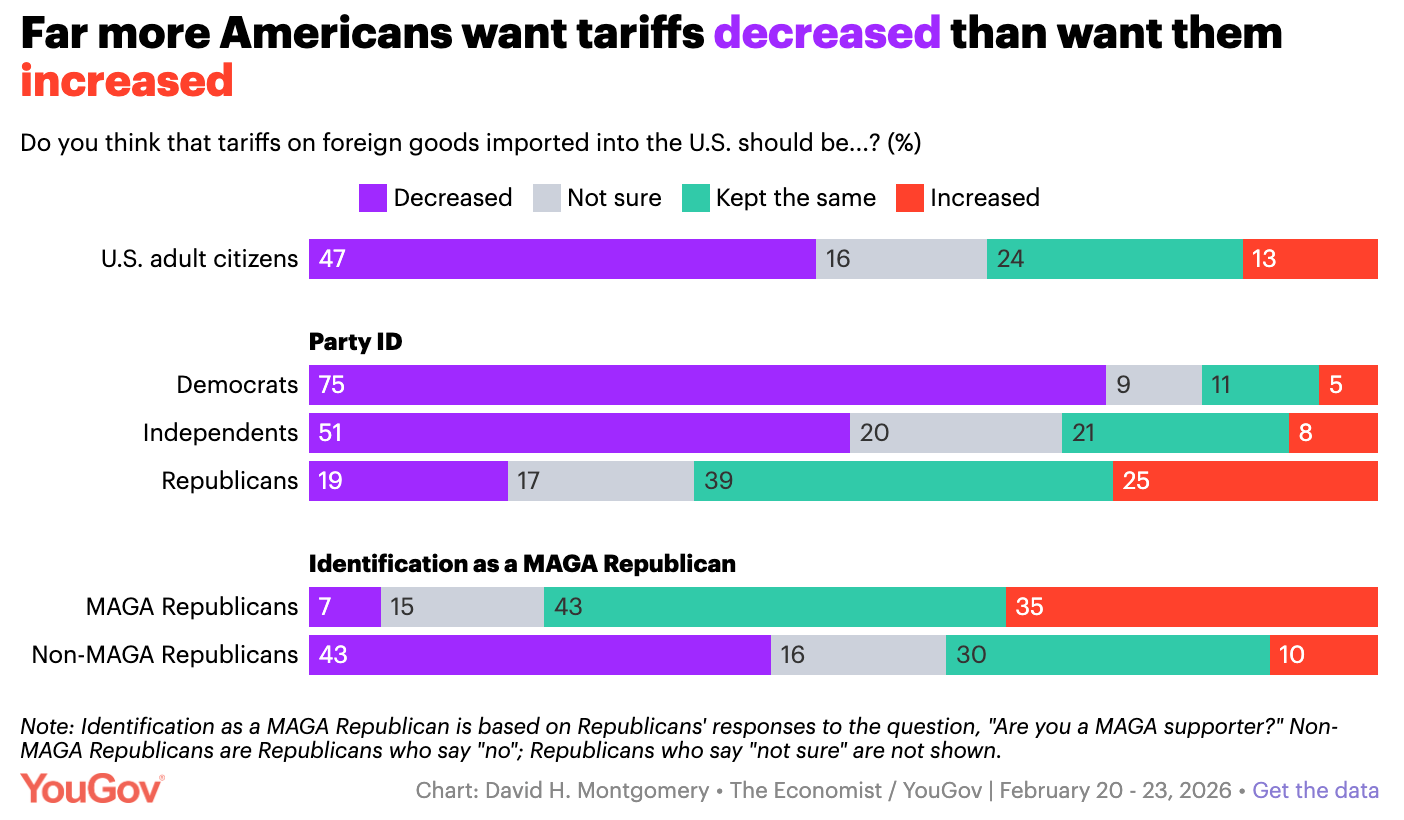
Mid-July Economist/YouGov polling shows that Republicans overall continue to most commonly favor keeping tariffs at their current level (40%), with only modest variance in their preference for either decreasing (18%) and increasing (29%) tariffs since the February poll.
Despite their mixed views on tariffs broadly, Republicans overall tend to recognize that trade with China, specifically, is important for the US economy. May 2026 YouGov polling found that a plurality of Republicans said trade with China makes the US “better off” rather than “worse off,” in line with broader public opinion. The poll also found that fewer Republicans now describe the US-China trade relationship as “unfair” than did so a year earlier — possibly reflecting the effects of the Trump-Xi summit and a broader softening in views of the trade relationship.
Taken together, these findings suggest broad, though uneven, skepticism toward a tariff-heavy economic standoff with China. For many Democrats, Independents, and non-MAGA Republicans, tariffs may look less like an effective strategy for protecting the US economy and more like a policy choice with direct consequences for prices, trade, and their everyday lives. In that context, continued economic engagement with China may appear more pragmatic than further tariff escalation.
Americans may be reassessing what US global leadership delivers
A second possibility is that changing perceptions of the United States itself are shaping the context in which Americans interpret claims about the “threat” of China. As US global leadership comes under increasing scrutiny — and the benefits of that leadership appear less clear at home — narratives presenting China as a central threat to the US-led international order may face greater skepticism. In this context, Americans may be more open to questioning not only the “threat” China poses, but also what the United States’ current model of global leadership actually delivers.
Doubts about the country’s moral authority and stabilizing role are one part of this context. A December 2025 NPR/Ipsos poll found that 61% believed the United States should be the moral leader of the world, but only 39% believed it currently is — down from 60% in 2017. International polling provides additional context for this gap. In a 2026 Pew survey across 36 countries, a median of just 35% said the United States contributes to global peace and stability, while 63% said it does not; in most countries with trend data, views had also become more negative since 2023. February 2026 Gallup polling found that Americans were broadly aware of their country’s reputational decline: 59% believed the United States was viewed unfavorably “in the eyes of the rest of the world.” Together, these findings provide a broader context in which claims about the legitimacy, credibility, and stabilizing value of US global leadership may be increasingly open to question.
Americans are also evaluating the country’s role in the world amid significant material pressures at home. In April 2026, a record 55% of Americans told Gallup that their personal financial situation was getting worse. The same share said recent price increases had created hardship in maintaining their standard of living, while inflation and high prices remained the most commonly named financial problem facing their families. Council on Foreign Relations listening sessions provide additional context for how these domestic pressures may shape views of foreign policy: participants emphasized that the United States’ role abroad should produce visible benefits for their communities, livelihoods, and economic wellbeing. Although these conversations were not nationally representative, they highlight how some Americans are evaluating US global leadership, in part, by whether it contributes to material wellbeing in their everyday lives.
That tension between global leadership and domestic needs is also visible in polling on Americans’ preferred role in the world. March 2026 Searchlight Institute/Hart polling found that majorities of both Democrats and Republicans preferred that the United States focus more on problems at home rather than maintaining American leadership abroad. This does not amount to a wholesale rejection of international engagement: February 2026 Gallup polling found that a plurality wanted the United States to play “a major” — though not “the leading” — role in world affairs. At the same time, combined support for the United States playing either a leading or major role has declined from an average of roughly three-quarters of Americans during the 2000s to 64% today. Read together, these findings suggest that many Americans remain open to international engagement, but support for an expansive US leadership role has weakened and may be especially conditional when weighed against domestic needs.
These political and economic concerns do not, on their own, explain why attitudes toward China are becoming less hostile. But they may be changing the terms on which Americans evaluate US global leadership and what it is meant to deliver. In that context, narratives presenting China as a threat to the existing order may carry less force. The question may be less whether China threatens that order than whether Americans continue to see the order—and the policies pursued to preserve it—as serving them in the first place.
Younger generations less likely to take up “China threat” narratives
These dynamics may also be reinforced by generational change. Younger Americans have come of age in a different geopolitical environment than older adults – one shaped by “forever wars,” financial crises, democratic backsliding, and the emergence of a more multipolar world. That context may contribute to a different orientation toward both US power and China’s rise: less attachment to narratives of US exceptionalism, less investment in preserving US global dominance, and greater familiarity with a world in which China is already a major global power.
These differences are visible in how younger and older Americans understand the United States’ place in the world — and what China’s rise would mean for them personally. A 2025 Carnegie survey found that majorities in every age group viewed the US as one of several powerful nations rather than the single most powerful country in the world, suggesting broad recognition that the global order is already multipolar. Younger adults, however, placed substantially less importance on US global power and influence: only 38% of Millennials and Gen Z described it as “very important,” compared with 56% of adults ages 45 and older. Younger adults were also far less likely than older Americans to say their lives would get worse if China surpassed the United States in global power and influence, while a meaningful share of adults under 30 believed their lives might even improve. Taken together, these findings suggest that younger generations are less likely to experience China’s rise as a direct threat to their own futures.
Younger Americans also appear less likely to rely on traditional “China-threat” frames that tend to dominate geopolitical discourse. The 2026 Ronald Reagan Institute’s Summer Survey found that younger adults were consistently less likely than seniors to express concern about a range of perceived China-related “threats,” including spying, technology theft, land purchases, and other perceived harms. According to May 2026 YouGov polling, younger adults also appear to hold less ideologically rigid views of the country, with fewer describing China as “communist” or “authoritarian” than their older counterparts, while often being more likely to say they were unsure. Taken together, these findings do not necessarily indicate more favorable views of China, but they do suggest less reliance on the ideological categories and threat frames that have traditionally structured US discourse about the country.
Importantly, these generational differences are also visible within the Republican Party. A January 2026 Pew Research Center survey found that younger Republicans were substantially less likely than older Republicans to describe China as an enemy, at 32% compared with 55%, and were just as likely as older Democrats to describe China as a partner, at 10% and 9%, respectively. A separate October 2025 Manhattan Institute survey of the “current GOP coalition” found that Republicans and Trump voters under 50 were also much more likely than older Republicans to view China as a country the United States should cooperate with, at 45% compared with 17%. These divisions suggest that younger Republicans may be less firmly attached to the party’s most confrontational China narratives, even while Republicans overall remain more likely than Democrats or Independents to see China’s development as a threat to US interests.
One factor that may be partially shaping this generational difference is younger Americans’ distinct media habits. US adults under 30 are less likely than their older counterparts to follow the news closely or to intentionally seek it out. Instead, younger Americans are more likely to learn about world events and politics passively, scrolling online. Because social media blends news with entertainment, travel, and everyday cultural content, younger Americans may encounter China through a wider range of reference points than global rivalry alone. These forms of exposure do not necessarily produce pro-China sentiment, but they may complicate older narratives that reduce China to authoritarianism, threat, or military competition.
Americans are showing more interest in cooperation
These trends do not indicate that concerns about China have altogether disappeared, but they do suggest that Americans are becoming less persuaded by a rigid enemy frame — and more open to a US-China relationship grounded in pragmatic cooperation.
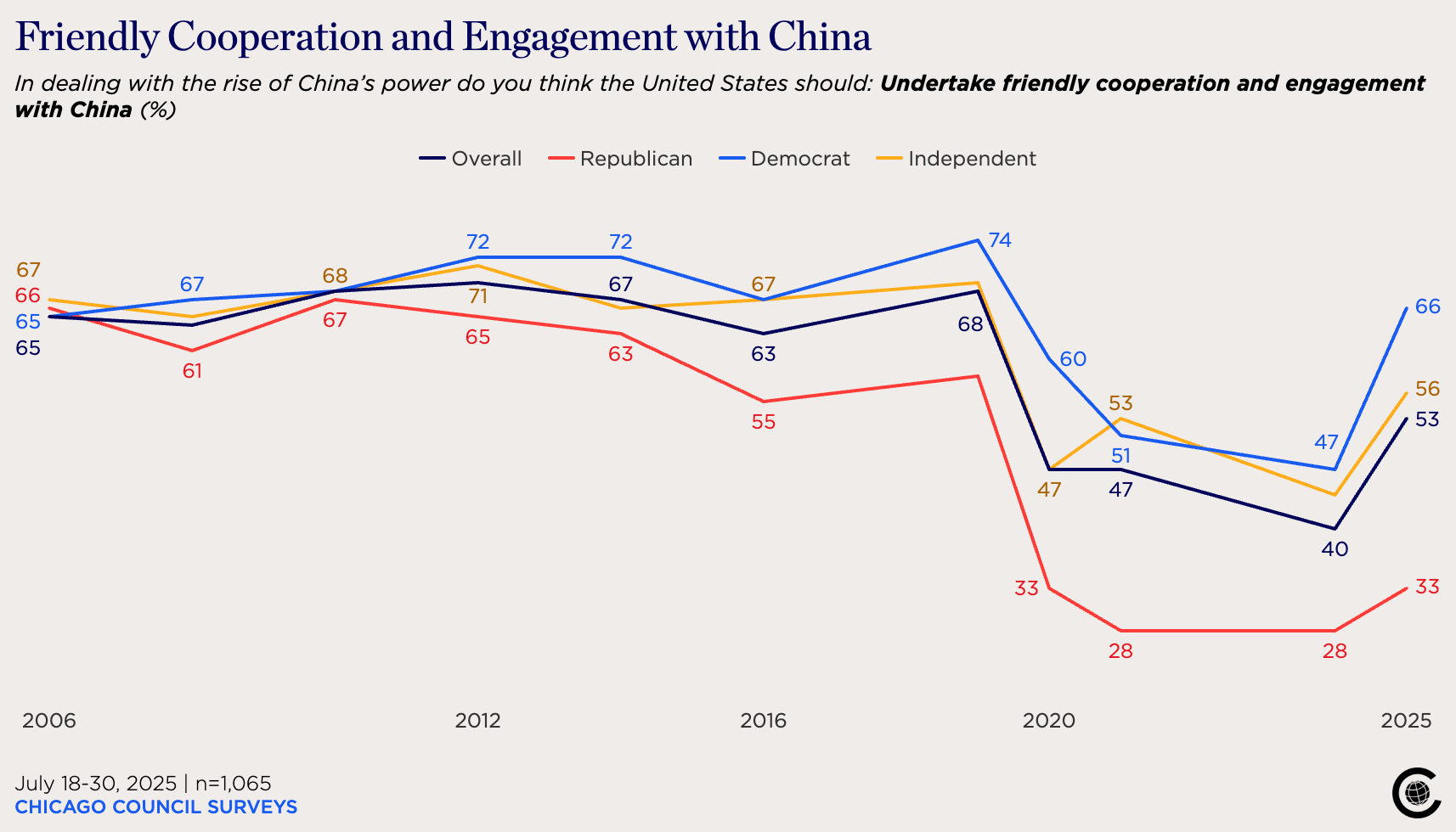
March 2026 Searchlight Institute/Hart polling found that Americans preferred improving relations and cooperating with China over focusing on limiting its global power, 50% to 40%. That shift is also visible in broader measures of engagement: Economist/YouGov polling from May shows a growing plurality favoring closer, rather than more distant, US-China relations, while the Chicago Council on Global Affairs found in July 2025 that 53% of Americans favored friendly engagement with China, up from 40% the year before.
Americans also appear especially receptive to cooperation when given clear visions of what sustained diplomatic engagement might look like. A January 2026 AFSC/Harris poll reminded respondents that, prior to 2017, the United States and China maintained official dialogue processes that contributed to cooperation on a range of issues. After receiving that context, 65% said the US government should engage in dialogue with China as much as possible to reduce tensions, compared with 22% who preferred not to restart official talks in order to maintain pressure on China.
At the same time, polling suggests limited appetite for direct confrontation. May 2026 YouGov polling found Americans divided between taking a strong stand to prevent China from taking Taiwan by force and prioritizing good relations with China, with nearly one-third unsure. This does not mean Americans are unconcerned about China, but it does suggest many are wary of treating military escalation as the default response.
The broader lesson is that public opinion may be moving toward a more flexible understanding of the US-China relationship. Americans still see China as a powerful global actor, but they are becoming less likely to view it strictly as an enemy. Most do not see its rise as a direct threat to their own lives, and increasingly they are open to dialogue and cooperation over confrontation. For advocates, policymakers, and communicators, the opportunity is to move beyond a zero-sum frame and show what a more constructive US-China relationship could materially make possible.
This research was made possible with the generous support of The Andrew Carnegie Foundation. Complete findings from ReThink Media’s polling synthesis can be found here.