Public Opinion Shifted on Palestine: How Should Advocates Build on That?
At ReThink Media, we closely monitor major public opinion surveys to understand how Americans perceive key issues, such as foreign policy and civic engagement. Over the past two years, one trend has been particularly notable: public opinion on Israel and Palestine has shifted dramatically. What was once seen as a fringe topic has become a source of public debate, political division, and even voter motivation.
Analyzing data from AP-NORC, YouGov/The Economist, The New York Times/Siena, and other major public opinion polls over the past two years, here are a few of the most striking trends we found:
- Growing skepticism toward Israel’s actions: Americans across age groups and political affiliations are increasingly questioning Israel’s conduct in Gaza since 2023, with many describing its actions as excessive or even genocidal.
- Declining support for military aid: Support for US military assistance to Israel has dropped notably, including among older Democrats and younger Republicans.
- Record-high sympathy for Palestinians: Polls show unprecedented levels of sympathy toward Palestinians, marking a historic shift in public sentiment.
- Independents moving closer to Democrats on this issue: A key voting bloc in US elections, independent voters, are showing less automatic alignment with Israel.
The Research and Analysis team at ReThink collaborated with the Rights and Inclusion collaborative to publish an analysis in Mondoweiss that explored these trends from the past two years in greater depth. In this blog post, we’ll build on that analysis by exploring why this shift matters and how advocates can build on it, including tips for messaging strategies.
Why This Shift Matters:
Public opinion on Palestine had already begun to shift before Oct. 7, 2023. A global survey by the Pew Research Center showed that negative views of Israel had risen sharply over the past decade, including in the US, where the share of adults with an unfavorable view of Israel increased by 11 percentage points between March 2022 and March 2025.
The shift accelerated dramatically after October 7 and the subsequent Israeli assault on Gaza that left the territory in ruins. What has been described as a “live-streamed genocide” brought the reality of the decades-long military occupation of Palestinian land, siege, and blockade of Gaza to millions of people around the world.
Several dynamics likely contributed to this rapid change in American public opinion. In this blog post, we focus on what stood out from our monitoring of media coverage.
As trust in traditional media has plummeted to historic lows, social media has become a primary source of news for many Americans. Over the past few years and, crucially during the genocide in Gaza, social media content from Palestinians on the ground challenged the way the Palestinian-Israeli conflict is covered in mainstream media. An investigation by The Intercept underscores this disconnect. In the early weeks of the genocide, American newspapers and cable news disproportionately focused on Israeli deaths, using emotive language to describe them, and even centering cases of antisemitism in the US over Islamophobia. The Intercept report concluded that news consumers who depended on those outlets were getting a “slanted picture” of the situation on the ground.
Meanwhile, social media platforms such as TikTok and Instagram offered a different picture. Journalists, youth, and ordinary people in Gaza documented the catastrophic human toll of the genocide in real time: children starving, entire neighborhoods leveled, hospitals, schools, mosques, and churches targeted and reduced to rubble. People were displaced numerous times due to Israeli evacuation orders, and others were gunned down while seeking food and aid, as in the now-infamous “flour massacre.”
This content, published by people living through the bombardment, shocked global audiences and ignited global protest. Videos posted by Israeli soldiers showing acts of cruelty toward Palestinians with open pride and mockery cast doubts on the long-held narrative that Israel was merely “defending itself.” Instead, they exposed a deliberate, systematic, and indiscriminate campaign targeting civilians and essential infrastructure: evidence of war crimes carried out with impunity.
As American officials uncritically repeated Israeli talking points, Israel’s favorability in opinion polls dwindled as Israel appeared to be losing the narrative war. As many of Israel’s claims were debunked, its justification for the relentless bombing of Gaza became impossible to reconcile with the staggering human cost. The result has been a reversal of decades of portraying Israel as the victim and Palestinians as the aggressors. The US government’s unwavering political and massive military support for Israel, even amid these atrocities, also jolted many Americans who had previously paid little attention to foreign policy.
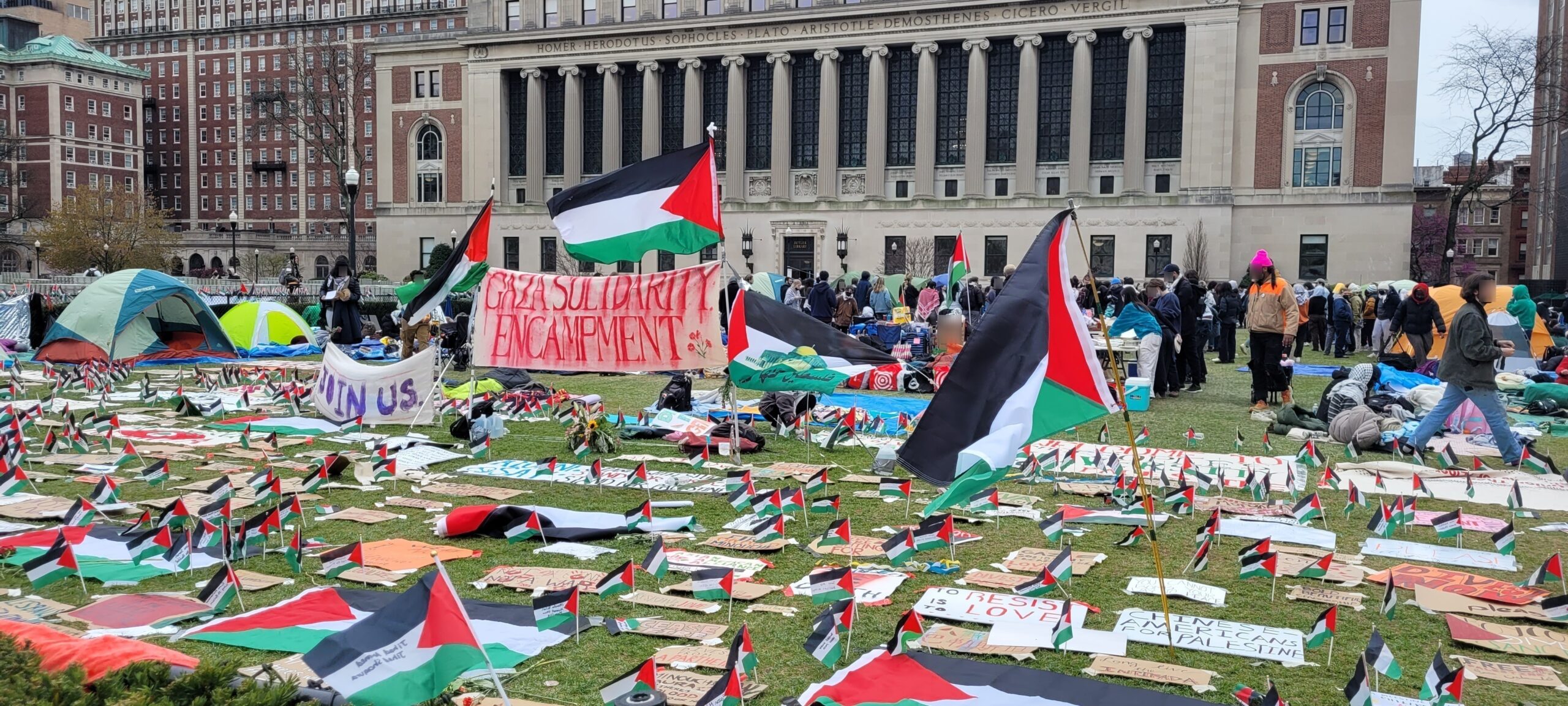
With the question of Gaza and US support for Israel becoming a topic of widespread discussion, we also witnessed an unprecedented wave of repression and demonization of pro-Palestine voices, particularly on college campuses. Across the US, police forces brutalized student activists and raided their homes, while the administration targeted universities through congressional hearings, demands to change their curricula, and crackdowns on international students and lawful residents for their political views. Additionally, public figures and ordinary people were fired from their jobs, and artists and cultural workers were retaliated against for defending Palestinian rights. What started as a repression of the pro-Palestine activists on campus and on the streets under the Biden administration slowly became a justification for Trump to introduce executive orders to punish and criminalize dissent altogether. Many likened the measures to McCarthy-era policies. By targeting college campuses and blackmailing their administrations into capitulation, the Trump administration was forcing higher education to align with its political agenda. The response from people in power to growing activism on Palestine made this issue the anti-war movement of our time, calling into question the very principles that the US claims to espouse as a democracy.
Increasingly, the question of Palestine and the US-Israel relationship has become an issue that extends beyond foreign policy into such realms as academic freedom, First Amendment rights, and the very credibility of US values. Some analysts have even argued that Gaza has defined former President Biden’s legacy.
The shift of Palestine from the margins to the middle became undeniable during the 2024 presidential election. As the Biden administration maintained its unwavering support for Israel, the Democratic establishment attempted to downplay Gaza’s impact on the race and even silenced those trying to bring attention to it. Recent polls show that nearly 30% of Biden voters who did not vote for Kamala Harris cited Gaza as their top reason. Some analysts believe that Harris’s decision not to break with Biden’s policies significantly hurt her bid. The 2025 New York City mayoral election is another example of the salience of Palestine in US politics. Exit polls showed that 68% of New Yorkers considered the candidates’ positions on Israel when they voted. For a long-ignored foreign policy issue to influence voter behavior marks a major political turning point.
With the ceasefire deal signed in October, public attention to conditions on the ground in Gaza may have faded, but the consequences for American politics remain to be seen. A recent story by the New York Times highlighted the now-toxic brand of the American Israel Public Affairs Committee (AIPAC) in American politics, noting a “realignment is underway in Congress on Israel.” More and more Democrats are now distancing themselves from Israel’s top lobby group by committing to refuse AIPAC money after pressure from constituents. Further, more representatives have signed on to a bill that would block weapons transfer to Israel, and local initiatives—like the city of Somerville, MA, becoming the first American city to divest from Israeli apartheid— are gaining steam.
On the right, we are also seeing signs of weakening support for Israel. While polls show most Republicans approve of Trump’s handling of the Palestinian-Israeli conflict, especially since the signing of the ceasefire agreement, some of the top MAGA-aligned podcasters and influencers—along with some of their fans—have broken with him on the issue.
All of this signals a major disruption of decades of bipartisan, unconditional support for Israel by US policymakers and the widespread economic, media, and academic complicity that enabled it. These shifts present a significant opportunity for advocates and politicians willing to remain true to their mandate and the democratic process. Without US backing, Israel’s impunity weakens dramatically.
How Can Advocates and Communicators Build on This Shift in Public Opinion?
As the polls show, far more Americans than ever have a better awareness of the humanitarian catastrophe in Gaza and, increasingly, US complicity in providing the political and military support for Israel to continue its human rights abuses. The challenge for advocates and communicators is to build on this momentum and move people from opinion to action. In the current political climate, there are several important opportunities to consider.
Research shows that people are more likely to act when they understand how an issue affects their own lives, communities, or values. Advocates can leverage this principle by helping Americans see that Palestine is deeply intertwined with American life, democracy, and everyday concerns, and that ending US support to Israel is in their best interest and in the interest of their communities.
This approach is not new. The movement for Palestinian rights in the US has long drawn connections between the oppression of Palestinians and that of communities of color, immigrants, and the working class in the US. These alliances helped build a base of supporters who see liberation for Palestinians as closely tied to their own. But with bipartisan disapproval of Israel now growing, so is the opportunity—and responsibility—to broaden our audience to include a diversity of political beliefs and backgrounds. We must demonstrate that this issue is not just a matter of foreign policy but one that affects Americans politically and materially. Our messaging and campaigns need to center the unifying concerns around this movement.
Today, many Americans across racial and political lines are grappling with the cost of living and political disillusionment. Viewed alongside the widening wealth gap and tax breaks for the richest Americans, the flow of public funds to Israel in the form of military aid becomes increasingly unjustifiable. Zohran Mamdani’s successful campaign for New York City mayor demonstrated the power of a message that combines moral clarity on Palestine with a concrete “affordability” agenda—even beyond New York City. To mobilize Americans, we must underscore our shared struggles and respond with concrete, principled action while upholding the values all Americans hold dear, like democracy, freedom, and fairness.
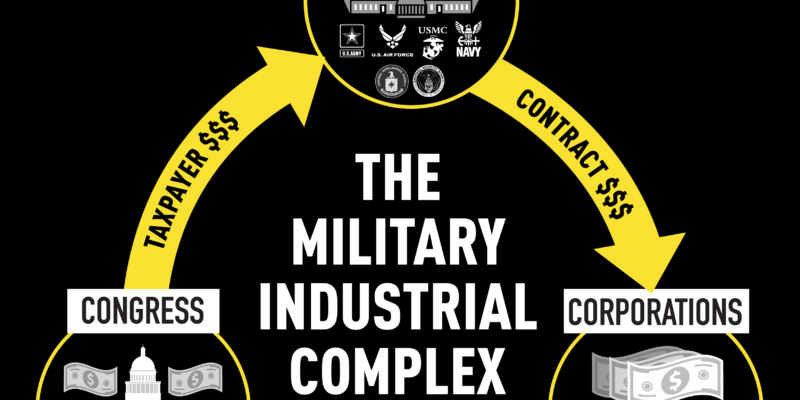
The complicity of American corporations in the genocide offers another avenue to make a relatable connection. The tech sector and “defense” corporation are deeply implicated in facilitating the kidnapping of migrants by ICE, and surveil Americans as they are in Israel’s assault on Gaza. Future organizing should build on the public’s growing distrust of corporate power, dislike of tech billionaires, and lack of accountability, and turn that frustration into collective action.
Tips for Advocates
Here are a few ways advocates can leverage these shifts in public opinion to strengthen their communications and organizing strategies:
- Emphasize shared values and shared harms.Connect the issue to American lives. Show that US complicity in Israel’s occupation and violence isn’t just a “foreign policy” concern. Continue to show the situation’s relevance to the American audience, while also highlighting the cost to their pocketbooks. Use clear, relatable examples, such as how much US taxpayer money goes to Israel’s military, and what that means for a struggling local community. Other ways to show shared harm is by emphasizing the role and influence of AIPAC and the pro-Israel lobby in American politics, building on Israel’s lack of popularity. This has the potential to resonate with voters across the political spectrum. And remember, when demonstrating harm, pair that with a way to repair.
- Leverage the bandwagon effect.The data indicate that supporting Palestinian rights is no longer a fringe position. Use this data when talking to new audiences, or to demonstrate to your existing audience of Palestinian rights supporters that they are part of a growing majority. Use the polls to demonstrate that supporting Palestinian rights is a common-sense issue and not a controversial one. Additionally, use polls to remind elected officials what their constituents want and to encourage them to take stronger stances on Israeli impunity; it is not only the moral thing to do but also a pragmatic choice.
- Diversify your digital and media strategy.With the fragmented media landscape, news consumers are now getting their news and information from a plethora of sources. At the same time, the consolidation we’re seeing in American media and social media companies is likely to result in more restrictions on the Palestinian narrative and that of justice movements more broadly. Ensure that, in addition to social media, you’re actively building your own audiences and spreading your messaging through owned tools like email, text, newsletters, Patreon subscriptions, etc., and through in-person events and campaigns.
- Always offer a path to action.End your communication with clear, relevant calls to action that align with your audience’s values and the issues and concerns they care about. If you are talking to new, sympathetic audiences, show them how they can turn awareness into impact, both locally and in their personal lives, as well as in elections. Highlight relevant campaigns and how to get involved, connect them to local activist groups, or even show them easy ways to support through product boycotts.