
What Americans Think About Iran’s Nuclear Status — And Why It Matters
As the US-Israeli war in Iran enters its third month, a new survey from ReThink Media sheds light on what American voters actually believe about Iran’s nuclear capabilities — and how those beliefs shape their threat perceptions.
The survey of 1,640 registered voters, fielded February 11–18, 2026 by YouGov, reveals a significant disconnect between public perception and the official rationale that has been used, at various points, to justify US military action. To view the survey questions and crosstabs, click here.
Most Americans don’t think Iran has nuclear weapons
Just 25% of Americans believe Iran currently possesses nuclear weapons. Nearly twice as many — 45% — believe Iran does not yet have nuclear weapons but is actively working to develop them. Another 26% say they are “not sure.”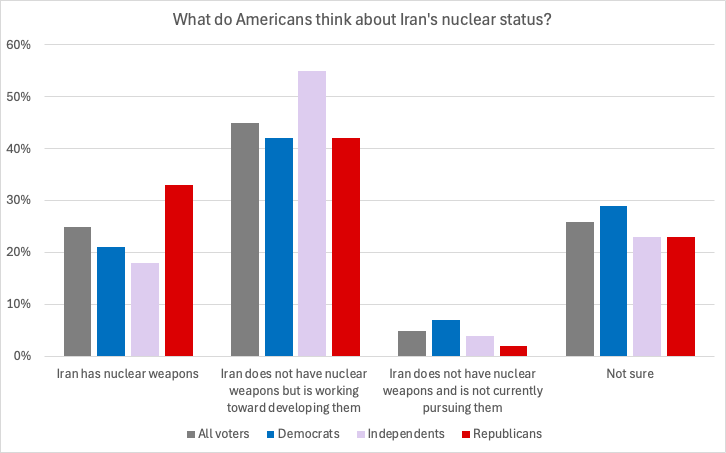
This matters because these are very different threat scenarios with very different policy implications — but the public may not always perceive them that way. When the administration (or the media) invokes “Iran’s nuclear program” without clarity, it can blur the line between a country that is pursuing a capability and one that already has it. Famously, in the leadup to the 2003 US war on Iraq, the lie that Iraq had Weapons of Mass Destruction (WMDs) was used to manufacture American consent for the war.
Views on Iran’s status differ modestly by political affiliation. Just under one-third of Republicans (30%) and Independents (29%) believe Iran already has nuclear weapons, compared with about one in five Democrats (20%). Roughly equal shares across party lines — between 42% and 46% — believe Iran does not yet have weapons but is developing them. Democrats and Independents are somewhat more likely to say they’re unsure.
Nuclear status drives threat perception
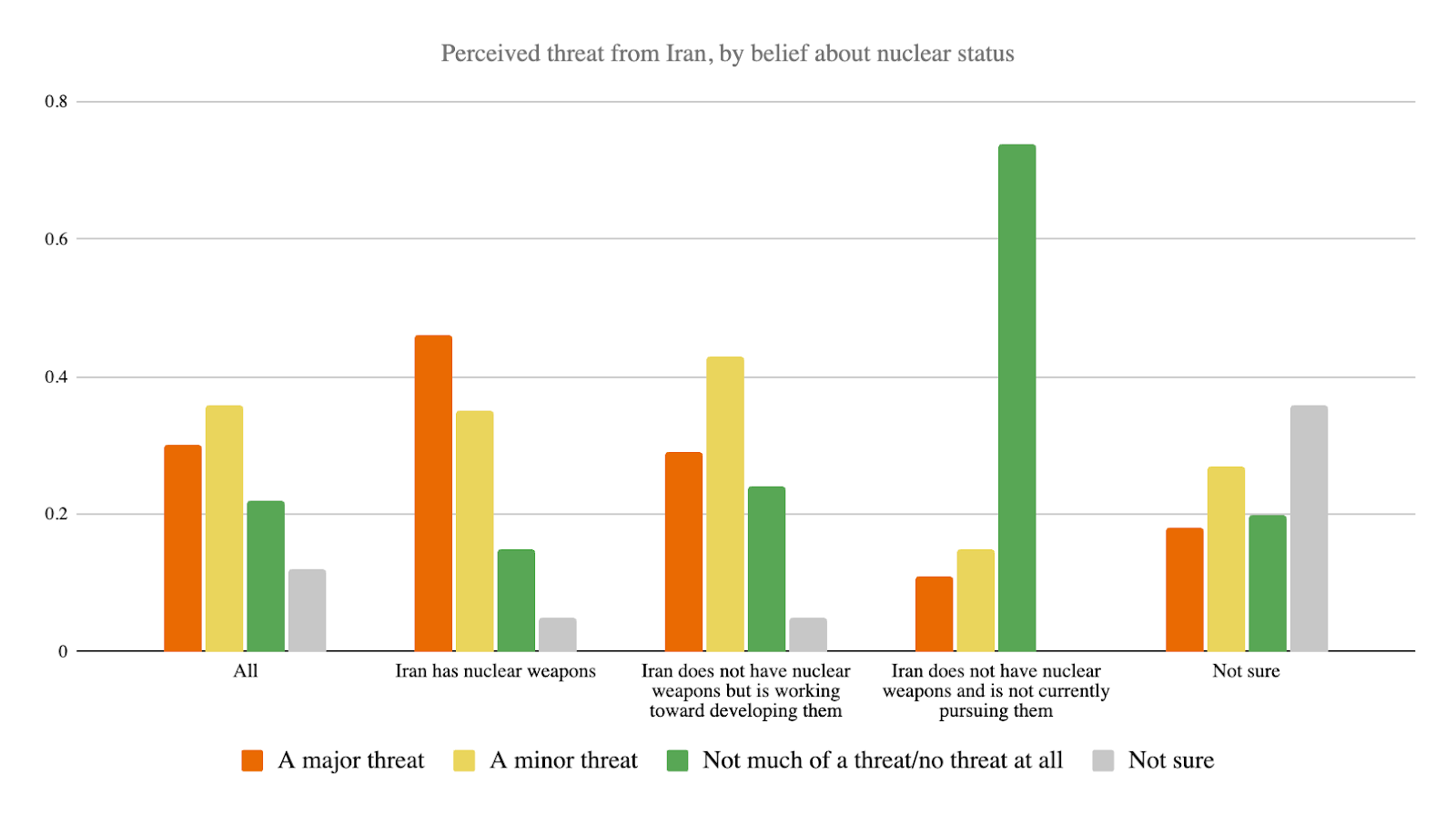
The survey also found that how Americans perceive Iran’s nuclear status is closely tied to how much of a threat they see Iran posing to the United States. Among those who believe Iran already has nuclear weapons, 46% describe Iran as a “major threat” to the US — compared with just 29% of those who believe Iran is still developing weapons, and 11% of those who believe Iran is not pursuing them at all.
This pattern holds regardless of party affiliation and suggests that public support for aggressive US policy toward Iran may depend, in part, on what people believe about Iran’s actual nuclear capabilities.
The broader context: nuclear framing matters for support
These findings align with a broader pattern visible across recent polling. A Reuters/Ipsos survey from early March found that roughly half of Americans say they would be more likely to support “continued US military action in Iran” when that action is explicitly framed as ending Iran’s nuclear program (48%) — the highest-performing frames tested in this survey. Further, Quinnipiac found more opposition than support (53% vs. 40%) for military action when nuclear weapons were not mentioned in the question framing.
More recent Data for Progress polling (March 13-15) shows that only 41% of Americans believe going to war with Iran is “worth the risk” because the country “is a threat to the US, Israel, and allies in the region,” while a larger share (52%) disagrees, indicating most Americans do not see Iran as a sufficient threat to justify war.
At the same time, a new Navigator Research poll released earlier this week finds that Americans oppose Trump’s military operation against Iran by nine points overall (40% support, 49% oppose). Two-thirds express concern that the US will become bogged down in a prolonged conflict (67%), and a majority believe Trump does not have a clear timeline or goals for the operation (53%).
The takeaway
Public understanding of Iran’s actual nuclear status is murky — a quarter of Americans believe Iran already has nukes, and another quarter aren’t sure what to think. This confusion creates fertile ground for framing effects: How political leaders and journalists describe Iran’s nuclear situation can meaningfully shape public support for military action.
This research was made possible with the generous support of Stand Together Trust, with additional thanks to Carnegie Corporation of New York and Ploughshares, whose funding supported the broader work surrounding this research.